M061982 · Pressure and gel in the amoeboid cytoplasm, 1923–1982 · strongly supported
Cytoplasm as a cross-linked actin gel: from Dujardin to the connectivity threshold
A bleb passes through gel-like states: it fills with fluid cytoplasm as it expands, a new cortex, a thin network of actin filaments and myosin motors, assembles under its membrane, and the bleb retracts once myosin arrives (Charras et al., 2006). Pollard et al. (1982) recast the contractile jelly of protoplasm as actin filaments cross-linked above a critical concentration, and two later results are strongly supported in vitro: an actomyosin gel contracts as a whole only above a threshold of cross-linking, and too much filamin or α-actinin, though not fascin, slows or stops the contraction.
Before
Protoplasm had long been pictured as a contractile jelly, from the sarcode of Dujardin (1835) to the firm plasmagel and fluid plasmasol of Mast (1923). Yet gelling and contracting seemed to oppose each other: contraction “must be in some way associated with solation”, Mast (1926, p. 408) wrote (M04). In extracts, a Dictyostelium gel containing myosin contracted only once it had been solated, “the gel prevents contraction” (Condeelis and Taylor, 1977, p. 917), and Hellewell and Taylor (1979) named this solation–contraction coupling: cross-links must loosen locally before myosin can slide the filaments past each other.
What was done
Polymer physics made ‘gelation’ precise. A solution of chains becomes a gel, a solid spanning the sample, once enough cross-links join the chains into one network, and the theory of Flory and Stockmayer predicts the critical cross-link density from chain length (Flory network theory). In actin, rigidity rose abruptly above a critical concentration of actin-binding protein (ABP), 4.5-fold higher than predicted, and shortening the filaments raised that concentration about as predicted (Hartwig and Stossel, 1979; table).
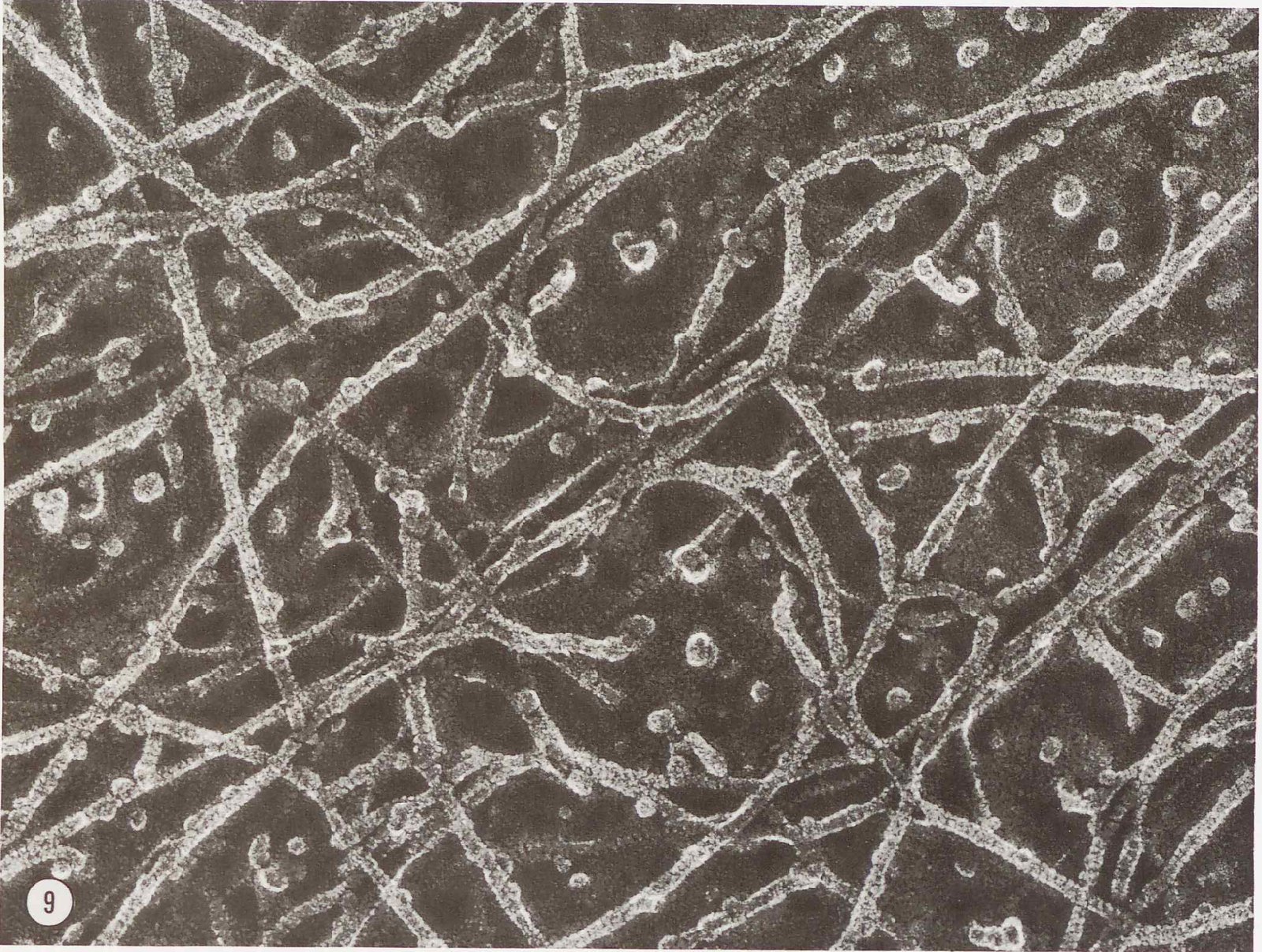
Pollard et al. (1982) held that “actin networks are the fundamental component of cytoplasmic structure” (Pollard et al., 1982, p. 513). With purified Acanthamoeba proteins, 50 nM of a calcium-sensitive gelation protein gelled 12 µM actin, micromolar calcium raised this critical concentration, and the gels were random meshworks with cross-links too sparse to see (figure).
Whether cross-linking helps or hinders contraction was disputed in the same year. Stossel (1982, p. 286) held cross-linking “required for the contraction to propagate”, whereas Taylor and Fechheimer (1982, p. 191) postulated that the most rigid gel “is an antagonist to contraction”. Later reconstitutions support both at different concentrations, so we read them as a lower and an upper bound. Filamin-gelled actomyosin contracted as a whole only above a filamin threshold, yet more slowly as filamin increased (Janson et al., 1991), and Janson and Taylor (1993, p. 353) concluded that “In a highly gelled system, no contraction will occur”. α-Actinin gels contracted only within a window of ratios (Bendix et al., 2008).
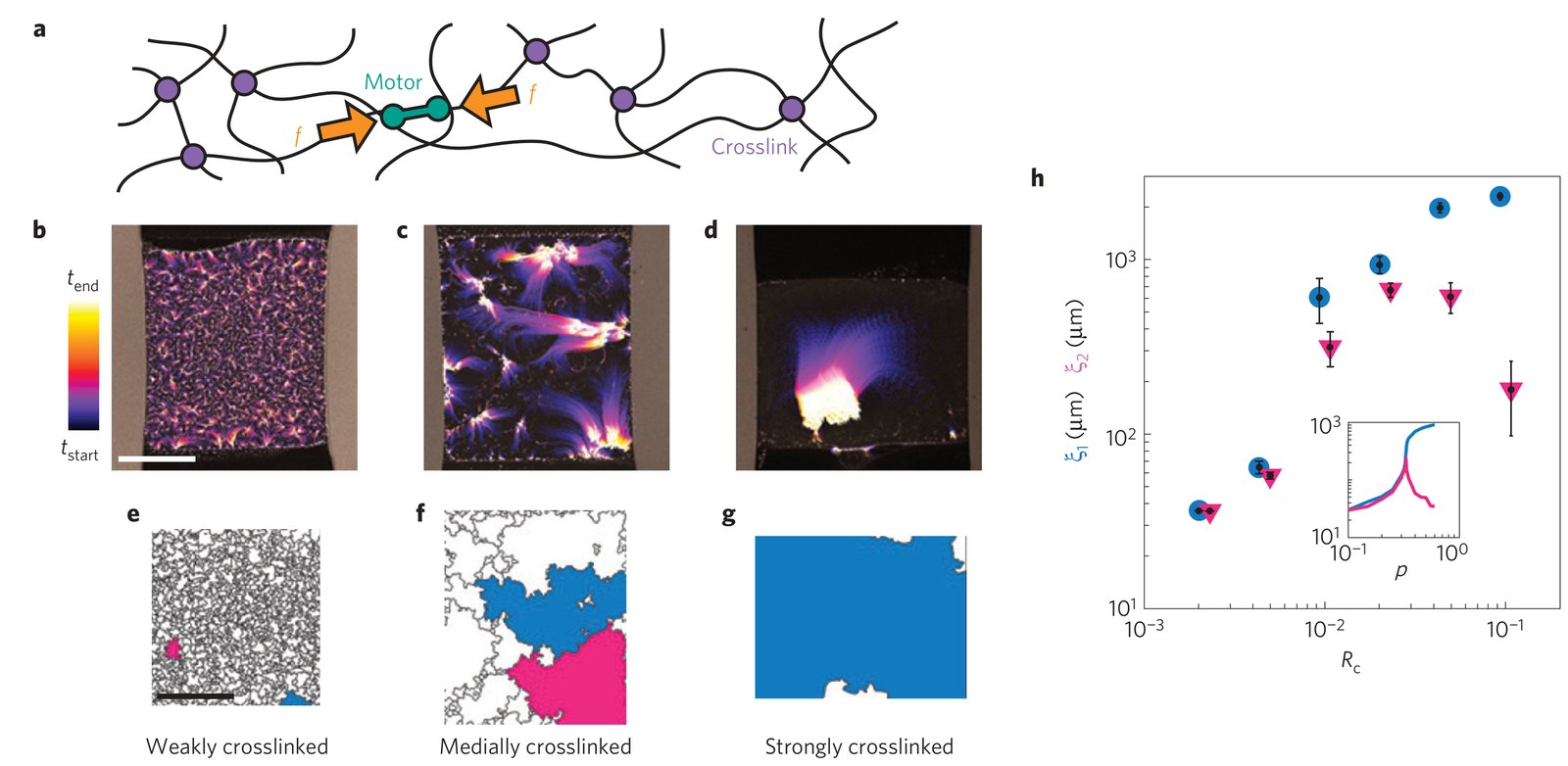
Alvarado et al. (2013) studied the lower bound with fascin in the language of percolation, the connectivity threshold at which a network first spans the system and can transmit force. Over a tenfold range of fascin to actin ratios (0.01–0.1) the gels were critically connected, with cluster areas following a power law (exponent −1.91 ± 0.06, fit error; figure). This critically connected state rests on the work of one group.
| Quantity | Value | System | Source |
|---|---|---|---|
| Flory gel point | critical ABP >15 µg/ml for 1 mg/ml F-actin, 4.5-fold above theory; ×2.67 after cytochalasin B (×2.2 predicted) | macrophage ABP | Hartwig and Stossel, 1979, Fig. 6; pp. 548–551 |
| Filamin threshold and slowing | local contraction at 400:1 actin:filamin, whole-sample from 200:1; ≈6-fold longer time to contraction at 75:1 (read from plot) | 1.5 mg/ml actin, actin:myosin 50:1 | Janson et al., 1991, Figs 5, 7 |
| α-Actinin window | contraction at α-actinin:actin 0.05–0.15, none above within 60 min; myosin:actin ≥ 0.003 | 23.8 µM actin, muscle myosin | Bendix et al., 2008, pp. 3129–3130; Fig. 2D |
What it changed
For most of its history this work ran beside bleb research, although Stossel and colleagues found that melanoma cells lacking ABP blebbed over their whole surface (Cunningham et al., 1992; M10). In our reading, the old and new descriptions concern one gel point, and solation–contraction coupling is its mechanical counterpart: a network must be connected to transmit force, but not so rigid that it cannot contract (proposed). The upper bound depends on the cross-linker: α-actinin above 30 nM blocks the contraction of reconstituted rings (Ennomani et al., 2016), whereas fascin gels are not inhibited (Alvarado et al., 2017).
Bleb mechanics took up these ideas late. In confined HeLa stable blebs, García-Arcos et al. (2024b ◆) measured an actin-occupancy threshold, p* = 0.59 (28 blebs, N = 3), and mapped the bleb’s front, middle and rear onto the connectivity regimes of Alvarado et al. (2017) (Physics of blebs). Cryo-electron tomography of cortices reassembled in blebs counted 0.5–1.4 potential cross-link sites per filament (Cassani et al., 2024 preprint), below the value of about 4 that these authors took from simulations (Ennomani et al., 2016).
Later work and open questions
The threshold is not a fixed composition: one fascin–myosin mixture contracted in thin chambers but not in 5 mm tubes (Alvarado et al., 2013; Alvarado et al., 2019). The reconstituted gels also lacked a membrane and turnover, and in 1982 no gelation protein was known to act in cells (Pollard et al., 1982). In cells, only confined HeLa stable blebs have been tested, and there a threshold was found but not the critical connectivity seen in vitro (García-Arcos et al., 2024b ◆). Whether the same window operates in amoeboid cytoplasm is therefore proposed.
Several questions remain open. Does amoeba cytoplasm cross a connectivity threshold between front and rear, and must the gel at the tail loosen before it contracts? Is the re-formation of a cortex under a bleb a gelation with a gel point (M13), and is cortex rupture at the start of a bleb a loss of connectivity (M15)?
References (20)
- Alvarado J, Sheinman M, Sharma A et al. (2013) Molecular motors robustly drive active gels to a critically connected state. Nat Phys 9:591–597. doi:10.1038/nphys2715
- Alvarado J, Sheinman M, Sharma A et al. (2017) Force percolation of contractile active gels. Soft Matter 13:5624–5644. doi:10.1039/C7SM00834A
- Alvarado J, Cipelletti L, Koenderink GH (2019) Uncovering the dynamic precursors to motor-driven contraction of active gels. Soft Matter 15:8552–8565. doi:10.1039/C9SM01172B
- Bendix PM, Koenderink GH, Cuvelier D et al. (2008) A quantitative analysis of contractility in active cytoskeletal protein networks. Biophys J 94:3126–3136. doi:10.1529/biophysj.107.117960
- Cassani DA, Martins B, Smith MB et al. (2024) Cryo-electron tomography reveals the nanoscale architecture of the actin cortex in cellular blebs. bioRxiv. doi:10.1101/2024.03.30.587413 preprint
- Charras GT, Hu CK, Coughlin M et al. (2006) Reassembly of contractile actin cortex in cell blebs. J Cell Biol 175:477–490. doi:10.1083/jcb.200602085
- Condeelis JS, Taylor DL (1977) The contractile basis of amoeboid movement. V. The control of gelation, solation, and contraction in extracts from Dictyostelium discoideum. J Cell Biol 74:901–927. doi:10.1083/jcb.74.3.901
- Cunningham CC, Gorlin JB, Kwiatkowski DJ et al. (1992) Actin-binding protein requirement for cortical stability and efficient locomotion. Science 255:325–327. doi:10.1126/science.1549777
- Dujardin F (1835) Recherches sur les organismes inférieurs. Ann Sci Nat Zool (2e sér.) 4:343–377. No DOI.
- Ennomani H, Letort G, Guérin C et al. (2016) Architecture and connectivity govern actin network contractility. Curr Biol 26:616–626. doi:10.1016/j.cub.2015.12.069
- ◆ García-Arcos JM, Ziegler J, Grigolon S et al. (2024b) Rigidity percolation and active advection synergize in the actomyosin cortex to drive amoeboid cell motility. Dev Cell 59:2990–3007.e7. doi:10.1016/j.devcel.2024.06.023
- Hartwig JH, Stossel TP (1979) Cytochalasin B and the structure of actin gels. J Mol Biol 134:539–553. doi:10.1016/0022-2836(79)90366-8
- Hellewell SB, Taylor DL (1979) The contractile basis of ameboid movement. VI. The solation-contraction coupling hypothesis. J Cell Biol 83:633–648. doi:10.1083/jcb.83.3.633
- Janson LW, Kolega J, Taylor DL (1991) Modulation of contraction by gelation/solation in a reconstituted motile model. J Cell Biol 114:1005–1015. doi:10.1083/jcb.114.5.1005
- Janson LW, Taylor DL (1993) In vitro models of tail contraction and cytoplasmic streaming in amoeboid cells. J Cell Biol 123:345–356. doi:10.1083/jcb.123.2.345
- Mast SO (1923) Mechanics of locomotion in Amoeba. Proc Natl Acad Sci USA 9:258–261. doi:10.1073/pnas.9.7.258
- Mast SO (1926) Structure, movement, locomotion, and stimulation in amoeba. J Morphol 41:347–425. doi:10.1002/jmor.1050410205
- Pollard TD, Aebi U, Cooper JA et al. (1982) Actin structure, polymerization, and gelation. Cold Spring Harb Symp Quant Biol 46:513–524. doi:10.1101/SQB.1982.046.01.048
- Stossel TP (1982) The structure of cortical cytoplasm. Philos Trans R Soc Lond B 299:275–289. doi:10.1098/rstb.1982.0132
- Taylor DL, Fechheimer M (1982) Cytoplasmic structure and contractility: the solation-contraction coupling hypothesis. Philos Trans R Soc Lond B 299:185–197. doi:10.1098/rstb.1982.0125