M122005–2009 · Blebs as physical objects · strongly supported
The physics of bleb growth: pressure, a poroelastic cytoplasm and a tension threshold
Between 2005 and 2009, blebs became gauges of the pressure that inflates them and the tension that generates it. Local drug perfusion pointed to a poroelastic cytoplasm, through which intracellular pressure spreads slowly (Charras et al., 2005, 2008), and laser ablation of the cortex showed that a bleb grows only above a threshold cortical tension (Tinevez et al., 2009). Both are strongly supported, although the threshold was measured in one cell type, and how fast pressure equalizes is still debated.
Before
Earlier models treated a bleb as membrane blown out by pressure according to Laplace’s law, with pressure and tension assumed (Prothero and Spencer, 1968; M07). Sheetz et al. (2006) later proposed that membrane over a hole in the cortex blebs once the hole’s radius exceeds \(2\sigma/p\), with \(\sigma\) the apparent membrane tension and \(p\) the excess pressure. Neither instant pressure equalization nor a role of cortical tension in bleb growth had been tested.
What was done
Charras et al. (2005) perfused drugs over one side of constantly blebbing M2 melanoma cells. Hyperosmotic sucrose, which draws water out of the cell, and inhibitors of myosin II or of Rho-associated kinase (ROCK) reduced blebbing on that side only, and actin-depolymerizing drugs, after first enlarging blebs everywhere, stopped it there only (figure). Had pressure equalized instantly, softening one side should have changed blebbing everywhere. The authors proposed instead that the cytoplasm is an elastic network soaked in cytosol, through which pressure spreads by flow of fluid:
Here x (µm) is the distance a pressure change spreads in time t (s); the poroelastic diffusion constant D (µm²/s) rises with the network’s hydraulic permeability k (µm² Pa⁻¹ s⁻¹) and bulk modulus K (Pa) and falls with its fluid fraction φ. As in a squeezed sponge, water takes time to flow out. By the authors’ estimate, pressure spreads about 10 µm in 10 s, slow enough for one side to bleb while the other does not.
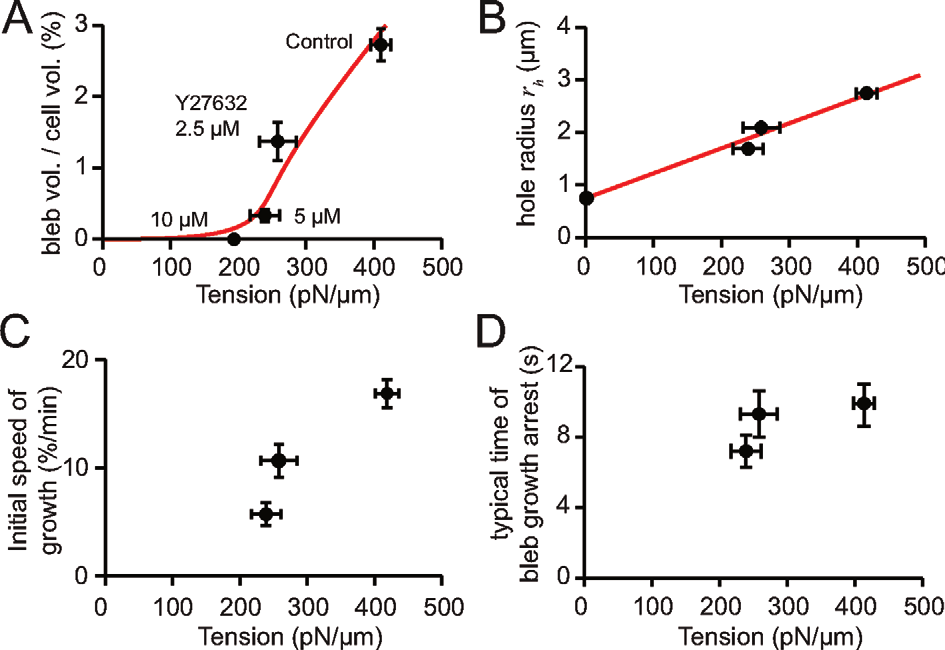
Tinevez et al. (2009) controlled the tension instead. A laser cut of about 1.5 µm in the cortex of suspended L929 cells produced a bleb that reached its maximal size within 10–30 s. When tension, measured by aspiration, was lowered with the ROCK inhibitor Y-27632, no bleb grew below about 200 pN/µm, and about half the cells blebbed at 240 pN/µm. Above this threshold, bleb volume, hole radius and growth speed rose with tension, but the time at which growth stopped did not (figure). A second bleb was about 25% smaller whether near or far from the first, which the authors read as fast pressure equalization in these cells.
Their model, an elastic contractile cortex around an elastic cytoplasm of fixed volume, gives a threshold that scales as
with \(\gamma_c^{*}\) the threshold cortical tension, \(\sigma_m\) the membrane tension (about 40 pN/µm), \(R\) the cell radius (about 8 µm) and \(r_h\) the hole radius (about 1 µm). In our reading, the cortex pressurizes the cell in proportion to \(\gamma_c/R\) (Laplace’s law), and a bleb grows once this pressure exceeds \(\sigma_m/r_h\), the pressure needed to push membrane through the hole. The scaling gives about 320 pN/µm, and the full calculation, with a hole that widens with tension, about 200 pN/µm. The model assumes constant membrane tension and a cortex about 100 nm thick.
| Quantity | Value | System | Source |
|---|---|---|---|
| Cortical tension, control | 413.6 ± 15.2 pN/µm (s.e.m., n = 32 cells) | suspended L929, aspiration | Tinevez et al., 2009, Fig. 3B |
| Threshold for expansion | 200–240 pN/µm (bracket, two conditions) | L929, Y-27632, ablation | Tinevez et al., 2009, Fig. 4A |
| Second/first bleb volume, near vs far | 0.76 ± 0.07 vs 0.75 ± 0.08 (s.e.m.; P > 0.9; ≈30 and ≈40 cells, counted from plot) | L929 | Tinevez et al., 2009, Fig. 2B |
| Poroelastic diffusion constant D | 5 ± 5 µm²/s (s.d.; 80 nucleoli, 47 cells); unchanged by ATP depletion | interphase HeLa, local hyperosmotic perfusion | Charras et al., 2009, Fig. 5B |
| Poroelastic diffusion constant Dp | 41 ± 11 µm²/s (error type not stated; 189 curves, 25 cells) | HeLa, atomic force microscopy | Moeendarbary et al., 2013, Fig. 1 |

What it changed
The work recast the cytoplasm as a porous, fluid-filled solid, and direct tests followed. In HeLa cells, one-sided hyperosmotic perfusion produced hydrated and dehydrated zones as little as 10 µm apart (Charras et al., 2009), and atomic force microscopy showed poroelastic relaxation within about 0.5 s (Moeendarbary et al., 2013).
Tinevez et al. also separated nucleation, which depends on membrane–cortex attachment and cortical integrity, from expansion, which needs tension above threshold, a distinction adopted by Paluch and Raz (2013). Theirs is the earliest threshold in cortical tension that we found, although Rentsch and Keller (2000) had measured the suction that starts blebbing. Because growth stopped at the same time whatever the tension, Tinevez et al. suggested, as Cunningham (1995) had, that cortex reassembly under the bleb membrane ends expansion (M13).
Later work and open questions
Whether pressure equalizes before a bleb has grown depends on the cell. In the amoeba Entamoeba histolytica, electroporating one site stopped blebbing over the whole cell at once (Maugis et al., 2010), whereas M2 cells kept blebbing for over 6 min beside a pipette that drained pressure (19 of 19 cells; Malboubi et al., 2026). The L929 two-bleb experiment has been read both ways. Simulations with a poroelastic cytoplasm gave a smaller second bleb, and their authors concluded that “lack of equilibration is essential to explain the results from Tinevez” (Strychalski and Guy, 2016, p. 1174). A simulation without pressure also gave a smaller second bleb (Spangler et al., 2011), so bleb size alone cannot decide. How fast pressure equalizes, relative to bleb growth, remains an open question.
The inputs of the threshold also vary with method and cell. Membrane tension ranges from 0.81 pN/µm by flicker spectroscopy of M2 blebs to 39.1 pN/µm by aspiration of L929 cells (Charras et al., 2008; Tinevez et al., 2009), and the HeLa cortex has a median thickness of about 170–400 nm rather than the 100 nm assumed (Chugh et al., 2017). See also Physics of blebs.
References (15)
- Charras GT, Coughlin M, Mitchison TJ et al. (2008) Life and times of a cellular bleb. Biophys J 94:1836–1853. doi:10.1529/biophysj.107.113605
- Charras GT, Mitchison TJ, Mahadevan L (2009) Animal cell hydraulics. J Cell Sci 122:3233–3241. doi:10.1242/jcs.049262
- Charras GT, Yarrow JC, Horton MA et al. (2005) Non-equilibration of hydrostatic pressure in blebbing cells. Nature 435:365–369. doi:10.1038/nature03550
- Chugh P, Clark AG, Smith MB et al. (2017) Actin cortex architecture regulates cell surface tension. Nat Cell Biol 19:689–697. doi:10.1038/ncb3525
- Cunningham CC (1995) Actin polymerization and intracellular solvent flow in cell surface blebbing. J Cell Biol 129:1589–1599. doi:10.1083/jcb.129.6.1589
- Malboubi M, Esteki MH, Vaghela MB et al. (2026) The cytoplasm of living cells can sustain transient and steady intracellular pressure gradients. eLife 14:RP105523. doi:10.7554/eLife.105523
- Maugis B, Brugués J, Nassoy P et al. (2010) Dynamic instability of the intracellular pressure drives bleb-based motility. J Cell Sci 123:3884–3892. doi:10.1242/jcs.065672
- Moeendarbary E, Valon L, Fritzsche M et al. (2013) The cytoplasm of living cells behaves as a poroelastic material. Nat Mater 12:253–261. doi:10.1038/nmat3517
- Paluch EK, Raz E (2013) The role and regulation of blebs in cell migration. Curr Opin Cell Biol 25:582–590. doi:10.1016/j.ceb.2013.05.005
- Prothero JW, Spencer D (1968) A model of blebbing in mitotic tissue culture cells. Biophys J 8:41–51. doi:10.1016/S0006-3495(68)86473-2
- Rentsch PS, Keller H (2000) Suction pressure can induce uncoupling of the plasma membrane from cortical actin. Eur J Cell Biol 79:975–981. doi:10.1078/0171-9335-00124
- Sheetz MP, Sable JE, Döbereiner HG (2006) Continuous membrane-cytoskeleton adhesion requires continuous accommodation to lipid and cytoskeleton dynamics. Annu Rev Biophys Biomol Struct 35:417–434. doi:10.1146/annurev.biophys.35.040405.102017
- Spangler EJ, Harvey CW, Revalee JD et al. (2011) Computer simulation of cytoskeleton-induced blebbing in lipid membranes. Phys Rev E 84:051906. doi:10.1103/PhysRevE.84.051906 (read as arXiv:1110.5414v1 preprint)
- Strychalski W, Guy RD (2016) Intracellular pressure dynamics in blebbing cells. Biophys J 110:1168–1179. doi:10.1016/j.bpj.2016.01.012
- Tinevez JY, Schulze U, Salbreux G et al. (2009) Role of cortical tension in bleb growth. Proc Natl Acad Sci USA 106:18581–18586. doi:10.1073/pnas.0903353106