M011755 · Seeing amoeboid movement and naming the bleb, 1755–1919 · established
Rösel's 'little Proteus', drawn changing shape
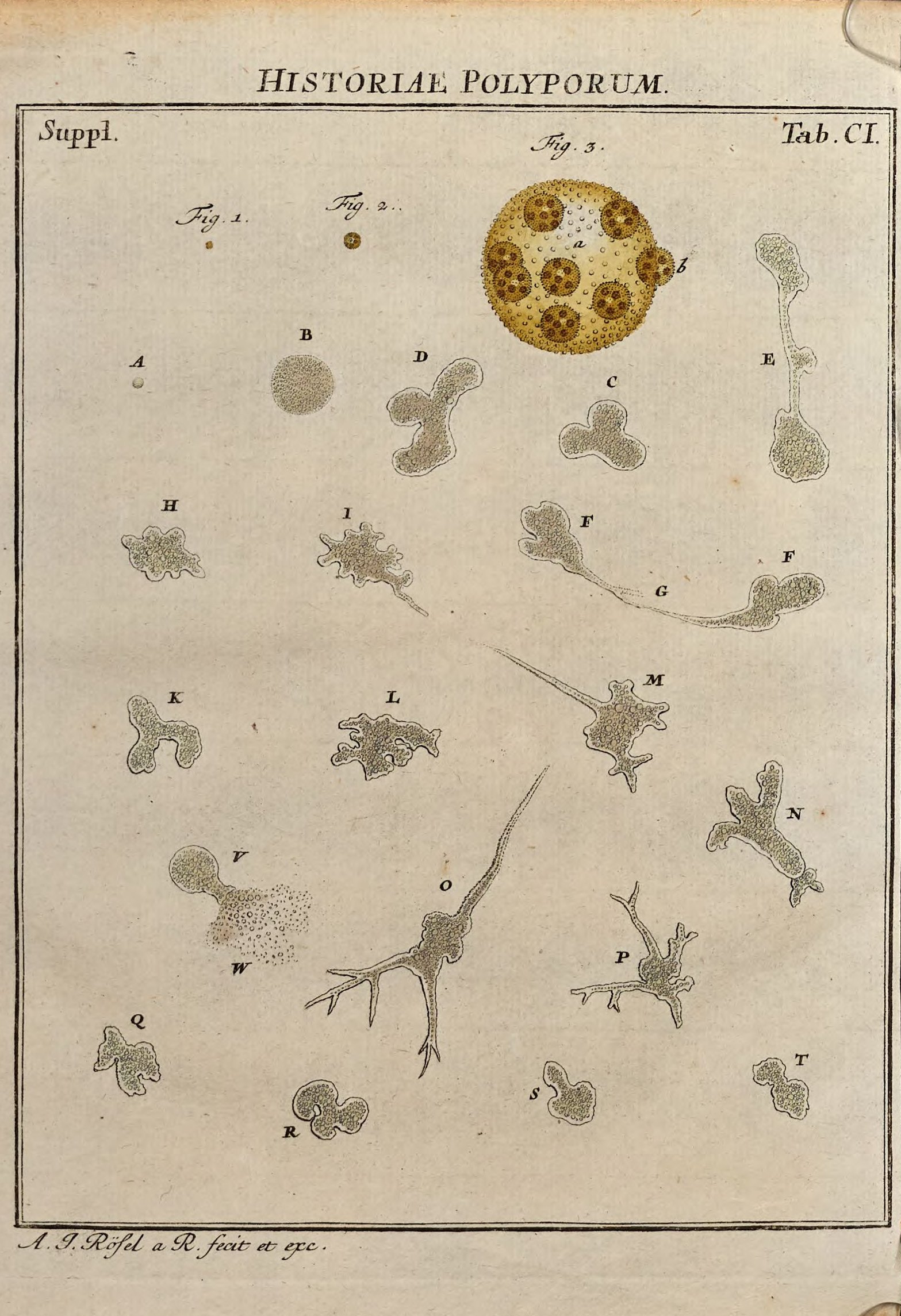
In 1755 Rösel von Rosenhof published, in the third volume of his monthly Insecten-Belustigung, a plate of a tiny freshwater animal with no fixed form. He called it the little Proteus, after the sea god who could take any shape, and drew one individual through a series of shapes until it split in two (Rösel von Rosenhof, 1755). Historians treat the plate as the first depiction of an amoeboid organism, one that moves by changing its shape (Lorch, 1973; Reynolds, 2008); as the starting point of that history it is established. Rösel described no bleb or mechanism, and his organism cannot be identified, but the plate opened the study of amoeboid movement from which bleb research grew.
Before
Naturalists then explained the movements of small animals by organs. Baker had explained the motion of a minute ‘globe animal’ by movable hairs; Rösel, unable to see them, proposed hollow warts that draw in and blow out water or air (Rösel von Rosenhof, 1755). Baker (1753) had also named a shape-changing animalcule Proteus, a long-necked creature that Ehrenberg (1838) identified as the ciliate Lacrymaria olor. Rösel never saw it but borrowed the name for an animal that shared its changing form (Rösel von Rosenhof, 1755, p. 621).
What was done
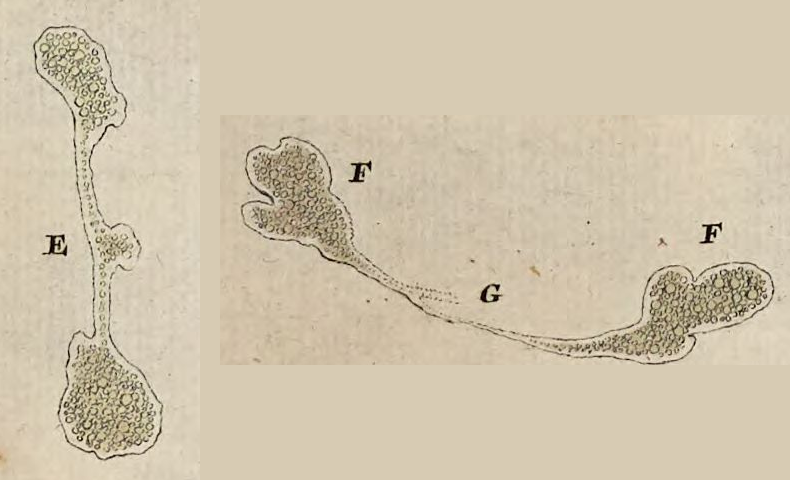
Rösel found his Proteus in a glass of standing water from the river Pegnitz. Watching such animals for hours in a watch-glass under a compound microscope, he never saw a fixed form, head, tail or legs, and he drew one isolated individual in sequence (Rösel von Rosenhof, 1755). It was first a ball (B), then a clover leaf (C), and took a new shape (D) in less than half a minute. It then lengthened into two masses joined by a thin strand (E), and the strand parted at G, leaving two bodies (F, F). “Nun hatte ich statt eines Thieres zweye” (now I had two animals instead of one), Rösel wrote (Rösel von Rosenhof, 1755, p. 622; translations on this page are ours). He followed one of the two through further forms until it became a ball with a neck (V), which he likened to a fire-spewing grenade, shedding fine granules (W); then it vanished from his sight.
Rösel also described the animal’s substance, clear granules of unequal size that it seemed to keep mixing. When touched it “zog es sich gleich so zusammen” (drew itself together at once) into a ball, and it changed shape again only once the water was still (p. 622). In every form the outline was the clearest part, “als ob sie eine besondere Einfassung hätten” (as if they had a special border; p. 622). Holding one animal with a pointed quill, he learned only that a delicate outer skin held the granules together: “wenn dieses zerries zerflos er vor meinen Augen” (when this tore, he flowed apart before my eyes; Rösel von Rosenhof, 1755, p. 623). The record is qualitative, from one observer and one drawn individual.
What it changed
The plate left a name and a starting point. Later names for the organism kept the idea of change, from Linnaeus’s Chaos protheus (Lorch, 1973; Reynolds, 2008) to Müller’s Proteus diffluens (Müller, 1786). Amoeba, from the Greek for ‘changing’ (Reynolds, 2008), was Ehrenberg’s respelling of Bory’s Amiba in 1830 (Ehrenberg, 1830, p. 61), and Ehrenberg dated the species Amoeba diffluens from Rösel’s find (Ehrenberg, 1838). Mast (1923) dated the study of Amoeba locomotion from Rösel (M04), and the name Chaos reached the laboratory in the giant amoeba Chaos chaos, whose streaming Allen and Roslansky (1959) measured (M05).
In our reading, some of these observations anticipate later work, although no source links them to Rösel: Jennings (1906) found that the touched part of a moving amoeba contracts and lets go of the surface, the clear border recalls the hyaline layer that Mast (1923) described, and cells that come apart into living pieces are the theme of M17.
Later work and open questions
What Rösel saw has never been settled. Identifications reviewed by Kudo (1959) ranged from Pelomyxa carolinensis to a slime mold, and Kudo judged the organism unidentifiable because the drawings carry no cytological information of value. Lorch (1973) also allowed a slime mold, warning that early drawings were often more beautiful than representative, whereas Reynolds (2008) calls Rösel’s the first amoeba without caveat; in our reading this reflects the limits of a drawing, not conflicting evidence. Even the size is uncertain: Kudo (1959) measured drawing A, given at natural size, at about 1.5 mm, whereas the scale bar of Lorch’s redrawing gives about 0.4 mm (Lorch, 1973).
Three questions remain: which organism this was, whether the clear border was an optical edge or a real outer layer, and whether the parting at G and the outpouring at V–W show division, breakage or disintegration (open question). Rösel read the parting as division and Pallas (1766) read the outpouring as a release of offspring, but Ehrenberg (1838) never saw such a division. The next page follows how ‘amoeba’ came to name a way of moving rather than one organism (Reynolds, 2008; M02).
References (12)
- Allen RD, Roslansky JD (1959) The consistency of ameba cytoplasm and its bearing on the mechanism of ameboid movement. I. An analysis of endoplasmic velocity profiles of Chaos chaos (L.). J Biophys Biochem Cytol 6:437–446. doi:10.1083/jcb.6.3.437
- Baker H (1753) Employment for the Microscope. London. pp. 260–266, Plate X no. XI. Internet Archive employmentformic01bake.
- Ehrenberg CG (1830) Beiträge zur Kenntniss der Organisation der Infusorien und ihrer geographischen Verbreitung, besonders in Sibirien. Abh Akad Wiss Berlin 1830 (Phys Abh):1–88, Taf. I–VIII. doi:10.5962/bhl.title.143632
- Ehrenberg CG (1838) Die Infusionsthierchen als vollkommene Organismen. Leipzig: Voss. pp. 125–129 (plates not seen). No DOI.
- Jennings HS (1906) Behavior of the Lower Organisms. New York: Columbia University Press. No DOI.
- Kudo RR (1959) Pelomyxa and related organisms. Ann N Y Acad Sci 78:474–486. doi:10.1111/j.1749-6632.1959.tb56118.x
- Lorch IJ (1973) Some historical aspects of amoeba studies. In: Jeon KW (ed.) The Biology of Amoeba. New York: Academic Press, pp. 1–36 (pp. 1–14 read). No DOI.
- Mast SO (1923) Mechanics of locomotion in Amoeba. Proc Natl Acad Sci USA 9:258–261. doi:10.1073/pnas.9.7.258
- Müller OF (1786) Animalcula infusoria fluviatilia et marina. Copenhagen: Möller (posthumous). pp. 9–11, 75–76, 176–177, Tab. II, XXV. Internet Archive b28772787.
- Pallas PS (1766) Elenchus zoophytorum. The Hague. pp. 28–29, 94–95, 416–418. Internet Archive elenchuszoophyto00pall.
- Reynolds A (2008) Amoebae as exemplary cells: the protean nature of an elementary organism. J Hist Biol 41:307–337. doi:10.1007/s10739-007-9142-8
- Rösel von Rosenhof AJ (1755) Der monatlich-herausgegebenen Insecten-Belustigung Dritter Theil. Nürnberg. pp. 615–624 (§7–19; 623–624 misprinted 223–224), Tab. CI. Staats- und Stadtbibliothek Augsburg copy, https://www.digitale-sammlungen.de/en/view/bsb11223426 (scans 797–807).