Nuclear blebs
Nuclear blebs are protrusions of the cell nucleus, a different structure from the blebs of the cell surface: what they are, how they differ, and a list of 350 papers.
A nuclear bleb is a protrusion of the cell nucleus. The nucleus is wrapped in a double membrane, the nuclear envelope, lined on its inner side by the lamina, a thin network of lamin proteins connected to the chromatin. When the nucleus is strongly deformed, the envelope can separate from the lamina and inflate into a round protrusion of nucleoplasm in which DNA is less dense than in the rest of the nucleus (Srivastava et al., 2021; Chu et al., 2025). The earliest use of the term we found, “nuclear membrane blebs”, comes from electron micrographs of Drosophila salivary-gland cells (Gay, 1956, p. 410).
Srivastava et al. (2021) compare these protrusions with the blebs of the cell surface, where the plasma membrane separates from the actin cortex, is inflated by pressure from actomyosin contraction, and is usually pulled back by a new cortex (Charras and Paluch, 2008; Tinevez et al., 2009). In both cases pressure pushes a membrane away from the network that supports it, as the round shape suggests. But the lamina has no known contractile activity, so the source of the pressure in the nucleus is unclear, and the membrane of a nuclear bleb lacks nuclear pores. Above all, nuclear blebs do not retract. They burst, the envelope is rapidly repaired, and new blebs form, burst and reseal for as long as the nucleus stays deformed, for over 10 h in confined cells.
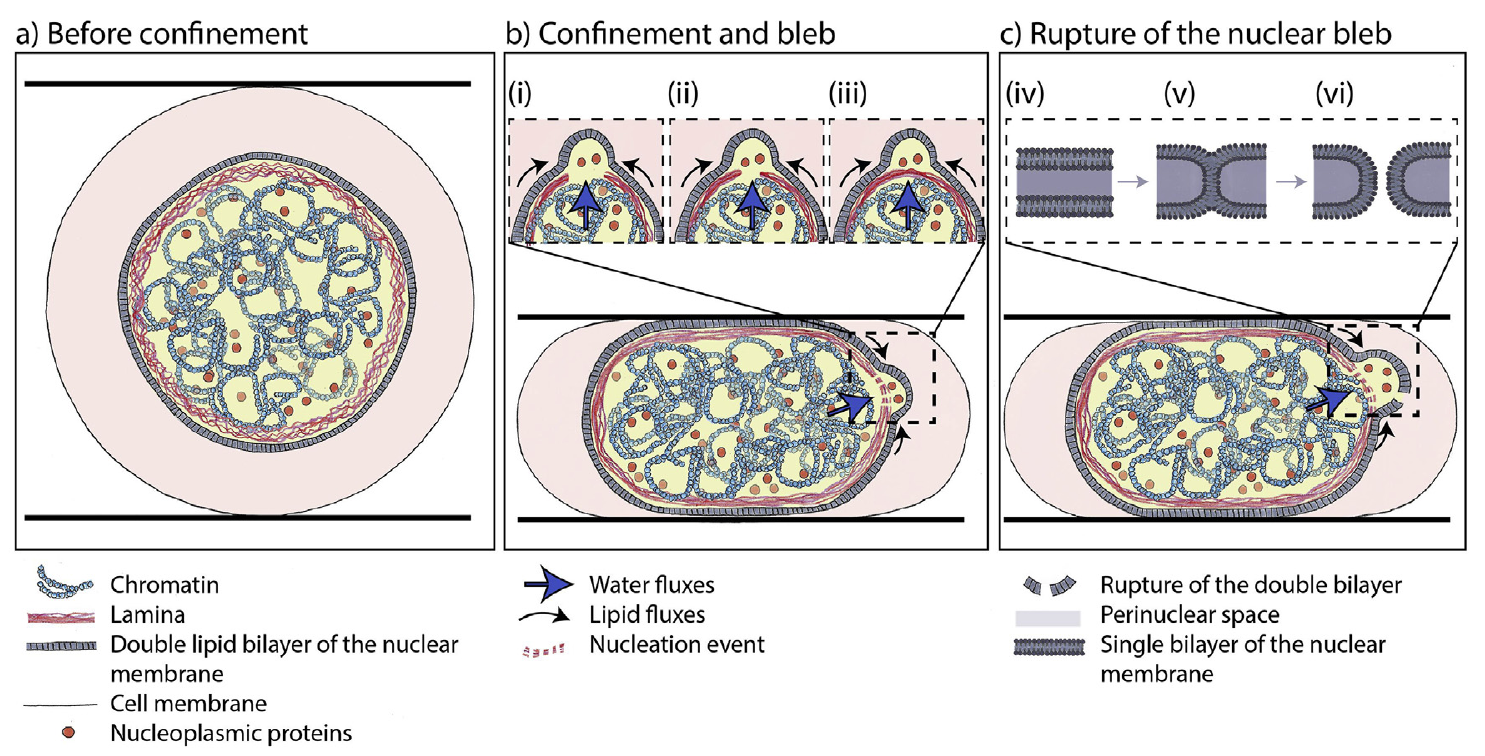
Each burst opens the nucleus to the cytoplasm, and Srivastava et al. (2021) regard nuclear blebs as the main source of such ruptures. By filming mouse embryonic fibroblasts and then staining the same cells, Chu et al. (2025) found that every bleb seen to rupture had lost lamin B1, whereas new blebs that did not rupture kept it. Nuclei with blebs also carried more DNA damage than normally shaped nuclei, whether or not their bleb had ruptured, so the authors read the bleb itself as a sign of nuclear dysfunction.
Nuclear blebs are therefore a different structure from the blebs of the rest of this site, and we cover them only briefly. A list of 350 papers on them, from 1956 to 2026, can be downloaded: nuclear blebs (CSV) · nuclear blebs (BibTeX) · nuclear blebs (RIS). It came from searches for the word “bleb”, so papers that use only other terms, such as “nuclear herniation”, are probably missing (Paper lists).
The nucleus has another role elsewhere on this site. In confined cells, its deformation has been proposed as a sensor of confinement that triggers cortical contraction and blebbing at the cell surface (Lomakin et al., 2020 ◆; Venturini et al., 2020; see M20).
References (7)
- Charras G, Paluch E (2008) Blebs lead the way: how to migrate without lamellipodia. Nat Rev Mol Cell Biol 9:730–736. doi:10.1038/nrm2453
- Chu CG, Lang N, Walsh E et al. (2025) Lamin B loss in nuclear blebs is rupture dependent whereas increased DNA damage is rupture independent. J Cell Sci 138:jcs263945. doi:10.1242/jcs.263945
- Gay H (1956) Chromosome-nuclear membrane-cytoplasmic interrelations in Drosophila. J Biophys Biochem Cytol 2:407–414. (DOI not recorded; PMID 13357577)
- ◆ Lomakin AJ, Cattin CJ, Cuvelier D et al. (2020) The nucleus acts as a ruler tailoring cell responses to spatial constraints. Science 370:eaba2894. doi:10.1126/science.aba2894
- Srivastava N, Nader GPF, Williart A et al. (2021) Nuclear fragility, blaming the blebs. Curr Opin Cell Biol 70:100–108. doi:10.1016/j.ceb.2021.01.007
- Tinevez JY, Schulze U, Salbreux G et al. (2009) Role of cortical tension in bleb growth. Proc Natl Acad Sci USA 106:18581–18586. doi:10.1073/pnas.0903353106
- Venturini V, Pezzano F, Català Castro F et al. (2020) The nucleus measures shape changes for cellular proprioception to control dynamic cell behavior. Science 370:eaba2644. doi:10.1126/science.aba2644